Progress billing: how to set your draw schedule
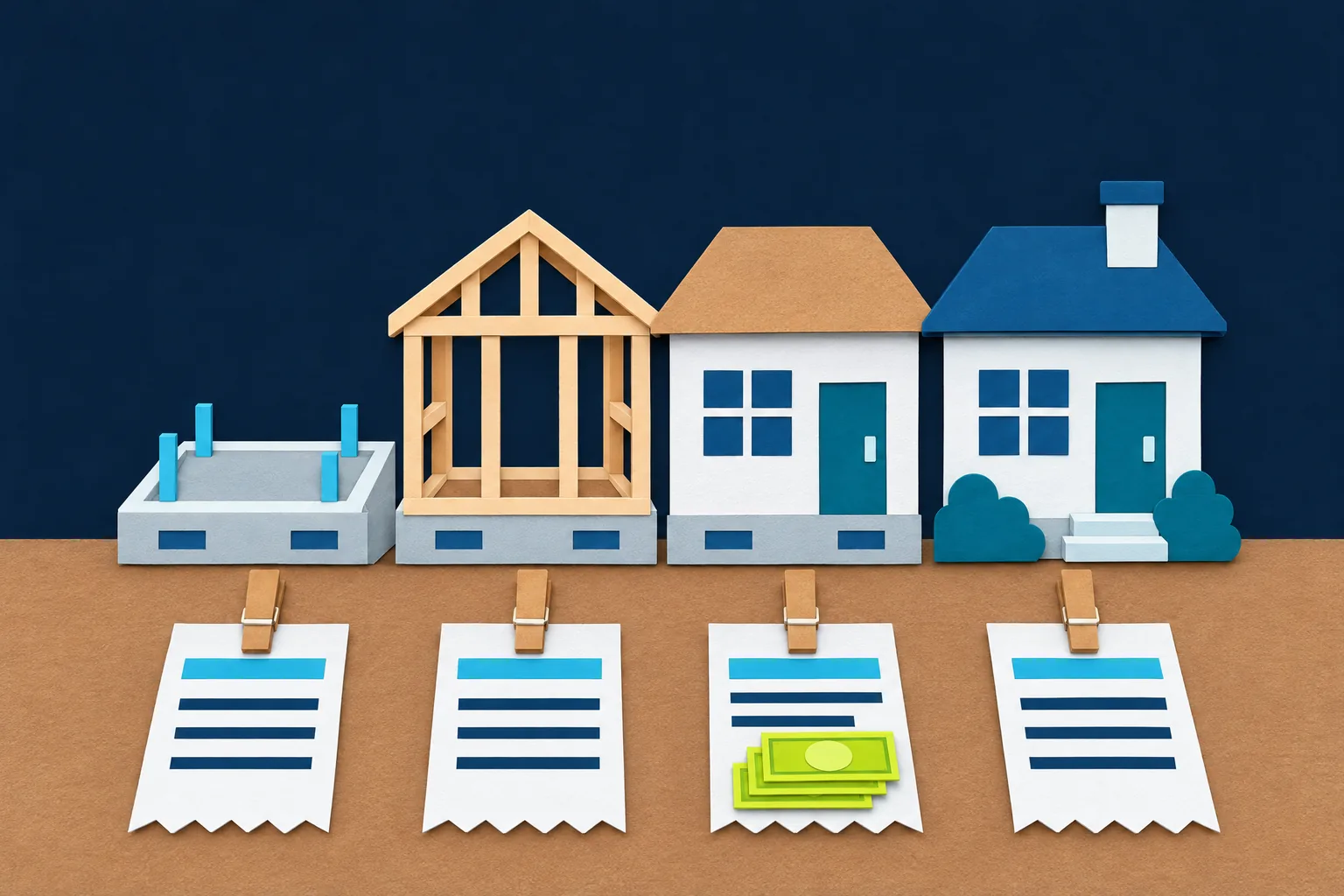
Progress billing means you invoice a job in stages as the work gets done, instead of sending one bill at the end. Each draw, the invoice for one stage, should cover the value of the work finished in that stage, and the stages should sit where your costs land. Set it up that way and the customer's money pays for the job instead of yours.
It's how remodelers, pool builders, roofers on big replacements and anyone else whose jobs cross a month-end get paid. On a 10-week remodel, a deposit-and-final schedule can leave you carrying almost half the job on your own bank balance. Five stage draws can keep you ahead the whole way. It's also the core of construction bookkeeping, which differs from service-shop books mostly in how long the money is out.
What is progress billing?
Progress billing is a payment schedule, written into the contract, that splits the price into a set of draws, often after a deposit. There are 2 common ways to size the draws:
- By stage: each draw is a fixed dollar amount due when a named stage is done: demo and framing, rough-in passed, cabinets set, final walkthrough. It suits residential work, because a homeowner can see whether a stage is done.
- By percent complete: each month you bill the share of each line of the contract that's finished, minus what you've already billed. A general contractor or commercial customer may ask for this on a pay application such as the AIA's G702 form, whose G703 continuation sheet "breaks the contract sum into portions of the work in accordance with a schedule of values". A schedule of values is the contract price split into lines of work, each with its own dollar amount.
Either way, the money question is the same: whether each draw arrives before the bills for that stage come due.
How do you set a draw schedule?
Start from your estimate, not from a habit like half down and half at the end.
- List the stages where money goes out. On a kitchen remodel that's demo and framing, rough-in, the cabinet and tile delivery, install, and the punch list. A stage where a big material order lands gets its own draw.
- Price each draw at the value of that stage. Take the stage's estimated cost and divide it by the same factor you priced the job with. On a job priced for a 30% gross margin (what's left after labor, materials and subs on the job), you divide by 0.7, so a stage that costs $14,000 is worth a $20,000 draw.
- Tie each draw to something the customer can see. "Rough-in inspection passed" beats "week 4". Nobody argues over a passed inspection.
- Write the trigger and the terms into the contract. Each draw is due the day its stage is signed off, and the next stage starts when the draw clears.
- Check your state's rules before you set the deposit. Deposit limits are state law. California, for one, caps the down payment at $1,000 or 10% of the price, whichever is less, and its required contract wording says "IT IS AGAINST THE LAW FOR A CONTRACTOR TO COLLECT PAYMENT FOR WORK NOT YET COMPLETED, OR FOR MATERIALS NOT YET DELIVERED". Other states set their own.
That rule is also why the material delivery earns its own stage. In California, the day the cabinets land on site is the first day you can bill for them.
A progress billing example
Here's an example remodeler with a $100,000 kitchen and bath remodel that should cost $70,000 to build, a 30% gross margin. The numbers are made up and rounded to show the math. The same job is billed 2 ways:
- Schedule A takes a 10% deposit and the rest at completion.
- Schedule B takes the same deposit plus 5 stage draws of $10,000, $20,000, $15,000, $25,000 and $20,000.
"Position" is billed to date minus cost to date, assuming each draw is paid the day it's billed.
| Stage done | Cost to date | A: billed | A: position | B: billed | B: position |
|---|---|---|---|---|---|
| Contract signed | $0 | $10,000 | $10,000 | $10,000 | $10,000 |
| Demo and framing | $7,000 | $10,000 | $3,000 | $20,000 | $13,000 |
| Rough-in passed | $21,000 | $10,000 | ($11,000) | $40,000 | $19,000 |
| Cabinets and tile delivered | $38,500 | $10,000 | ($28,500) | $55,000 | $16,500 |
| Install done | $56,000 | $10,000 | ($46,000) | $80,000 | $24,000 |
| Final walkthrough | $70,000 | $100,000 | $30,000 | $100,000 | $30,000 |
Both schedules end at the same $30,000 gross profit. The difference is who funds the job on the way there. Under Schedule A, you're $46,000 out of pocket the week before the final bill, almost half the price of the job, carried on your bank balance or your line of credit. Under Schedule B, the customer's money stays ahead of your costs at every stage. In California, this job's deposit would be capped at $1,000, which makes the stage draws matter even more.
The table leaves out 2 things. Customers don't pay the day you bill, so if a draw takes 10 days to clear, Schedule B dips for those 10 days and a payroll can land in the gap. And rent, the office and the truck note keep running while the job does. Put each draw's expected date into your cash flow forecast for contractors so you can see those weeks coming.
With YetiBooks you get one profit specialist, the same person every time (how it works).
How does progress billing tie to the WIP report?
Your draw schedule fills one column of the construction WIP report: billed to date. The WIP report sets it beside earned revenue, the share of the contract you've earned by the work done (contract × cost to date ÷ estimated total cost). The gap tells you whether your draws are tracking the work.
- Billed ahead of the work is overbilling. On Schedule B, after demo and framing the job has earned $10,000 and billed $20,000, so it's $10,000 overbilled. All of that is the deposit, which is normal. It's still money you owe back in labor and materials, so don't spend it.
- Billed behind the work is underbilling. If the crew finished rough-in on the 28th and the draw didn't go out until the 5th, the month-end WIP shows the job $10,000 underbilled (earned $30,000, billed $20,000), and your bank account is still waiting on the whole $20,000 draw.
Book the deposit to a customer deposits account, which is a liability, not to income. Otherwise the P&L shows a profit the month you sign the job and a loss the months you build it. The construction chart of accounts has the account for it.
Where do retainage and change orders fit?
Two things change what the draws bring in.
- Retainage: on commercial work, or when you're a sub to a GC, the customer may hold back a percentage of every draw until the job is finished. That money arrives long after the work is done. Bill the full draw, show the amount held on the invoice, and track it by job.
- Change orders: a signed change order adds its own line to the schedule with its own draw. Bill it when that work is done, not at the final, or you're financing the customer's extras.
Pay commission on draws, not on contracts
If a salesperson or project manager earns commission, stage billing changes when you pay it. A pool company owner we work with was worried about paying commission before the customer's money was in hand. Here's how we told him to handle it:
I would never pay 5% of the entire job when I got a deposit. I would pay 5% of the deposit. … if it's a $20,000 job and you're only getting $5,000, I'm paying 5% of $5,000. And then when you get the other $15,000, I pay 5% of the $15,000.
On the example job, a 5% commission paid at signing is $5,000 out the door against a $10,000 deposit. Paid draw by draw, it's $500 at signing, and the rest follows the cash. California requires it on home improvement contracts: when the price includes a salesperson's commission, the CSLB's contract guide says it's paid "on a pro rata basis in proportion to the schedule of payments made to the contractor." Your own pay works the same way: take it from draws collected, not from the contract total.
Your progress billing routine
Here's who does what, and when, for a remodeler with an office manager and a lead carpenter or project manager:
- The day a stage is done, the lead texts the office a photo and a one-line sign-off: the stage, the date and anything left.
- The same day, the office sends the draw invoice with the stage, the amount, the total paid to date and the balance left, due on receipt.
- Every Monday, the office checks open draws against the schedule. A draw unpaid after 7 days gets a phone call, and the next stage waits if the contract says so.
- By the 10th of the month, once the books close, the WIP report shows billed against earned for every open job. Any underbilled job gets its draw sent that day.
Questions owners ask
Is progressive billing the same as progress billing?
Yes. Progressive billing is another name for progress billing: you invoice a job in stages as the work gets done, not all at the end.
Is progress billing the same as milestone billing?
They're close. Milestone billing ties each payment to a named stage, while progress billing can also mean billing a percentage of the work done each month. On a residential remodel, stages are easier for the homeowner to check, and the steps above work for both.
Can I bill for materials before they're installed?
It depends on your contract and your state. In California, you can collect for materials once they're delivered to the job, not before, and a special order doesn't raise the deposit cap: the CSLB says "There are no exceptions for special-order materials." On the WIP report, leave those materials out of cost to date until they're installed, so the job shows that draw as overbilled until the crew puts them in.
What if the customer won't pay a draw?
Call the same day it's late, and hold the next stage if your contract allows it. Lien rights come with deadlines set by state law, so learn yours before you need them. The accounts receivable guide for contractors covers what to do when a builder stalls.
Keep the customer's money ahead of your costs
Before you sign the next job, set a draw at each stage where money goes out, priced at that stage's value and tied to something the customer can see. On the example remodel, that's the difference between carrying $46,000 on your own bank balance and staying ahead at every stage. If your jobs look more like Schedule A and you can't tell which ones you're funding, bring your open jobs and last month's P&L to a free profit call and we'll look at which jobs your numbers say you're funding.